
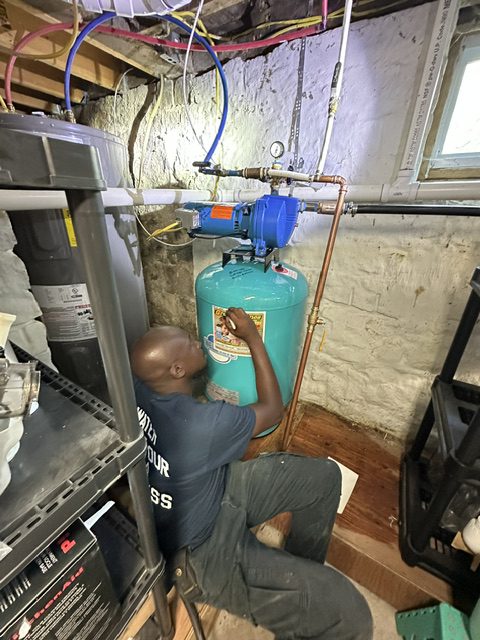
Have you turned on your faucets and noticed little or no water coming out? It can be disappointing and concerning, especially if you are unsure what is happening with your water well system. In many cases, the issue may be that the jet pump has lost its prime. Re-priming is often a straightforward process, although it may need to be repeated a few times to fully restore normal water pressure.
If re-priming does not bring back steady flow, it could be a sign of a deeper problem such as an air leak, a failing suction line, or an issue with the pressure tank or pressure gauge. These problems can prevent the jet pump from creating the vacuum needed to draw water and maintain a prime.
Whether you need guidance with re-priming your jet pump or help diagnosing a more complicated issue, the team at Greco and Haines is here to assist. We help Connecticut homeowners with all types of water well and pump concerns, and our dependable services are available every day of the week.
Priming a Well Pump
Priming a jet pump means filling the pump and suction line with water so air can be cleared from the system. Removing trapped air allows the pump to create the vacuum needed to draw water from the well. Without proper prime, the jet pump cannot build the water pressure required to supply the home.
Not every type of pump needs priming. Submersible pumps sit underwater near the bottom of the well and remain primed on their own. Non-submersible or self-priming models usually only need priming during installation or after the system has been opened for service.
Above-ground jet pumps, however, can lose their prime for several reasons. A low or overdrawn well can introduce air into the system. A loose or failing foot valve or check valve can do the same. Air leaks in fittings, seals or the suction line may allow the pump to pull air instead of water. Even a minor leak or faulty priming plug can prevent the pump from holding prime.
It is important to address a jet pump that has lost its prime as soon as possible. Running a jet pump while it is pulling air can cause overheating, reduce efficiency and eventually damage the motor. Restoring prime quickly helps protect the equipment and prevents avoidable repair or replacement costs.
How to Prime a Well Pump
To prime a jet pump, you must fill the pump housing and suction line with water so the system can remove any trapped air. Before you begin, take a few minutes to inspect the pump and nearby components. Look for leaks, loose fittings, corrosion or anything that could allow air to enter the system. If you notice an air leak or a problem with the suction line, these issues should be corrected before priming will work.
Always start by turning off electrical power to the pump at the circuit breaker. Locate the priming plug, which is usually a square or hexagonal plug on the top of the pump housing. Remove the plug and open any pressure-release valves on the system. It can also be helpful to check the pressure gauge so you know what the system is reading before you add water.
Fill the jet pump casing slowly with clean, safe drinking water. You can use a lead-free hose, a pitcher or a funnel depending on your setup. Add water carefully so nothing spills onto the pressure switch or wiring. Continue filling until water reaches the top of both the priming opening and the release valves.
Once the jet pump housing is full, replace the priming plug securely. Restore power at the breaker and allow the pump to run. If the system builds water pressure and shuts off on its own, the prime has been restored. Close the release valves and test a faucet to confirm steady flow.
If the jet pump does not prime on the first attempt, repeat the process. Some systems require several rounds of priming before they begin drawing water normally, especially if the jet pump has been sitting idle or the lines were recently opened for service.
The Benefit of a Professional Well Specialist
If you are unable to re-prime your jet pump, there is often a deeper issue at play. A trapped air pocket or loose fitting is sometimes the cause, but more serious problems such as a failing foot valve, a worn check valve, a damaged suction line or a leak somewhere in the system can prevent the pump from holding prime. In some cases, the pump itself may be declining or unable to build water pressure the way it should. Tracking down the exact issue is important, because a jet pump that continuously loses prime will eventually suffer damage or stop working altogether.
This is where the professionals at Greco and Haines can help. Our team has more than half a century of experience working with Connecticut well systems, and we have seen every type of pump malfunction and system failure. We understand how to diagnose problems accurately, whether the issue involves the pump, valves, pressure tank, water lines or the well system as a whole. When a jet pump will not prime, it is a clear sign that something needs prompt attention, and our technicians are ready to help restore your water supply quickly and safely.
For more information about our well water services in CT, contact us today via our online contact form or call any time! 203-735-9308 or 203-777-2256 or Call Toll-Free from any CT Area Code 1-800-922-2958.